Mobile Game GUI Pack 04: A Complete UI Toolkit for Developers
Imagine this: you have spent months coding the physics engine, perfecting the gameplay loop, and debugging the logic for your new 2D mobile title. The game is fun, but when you pull up the default gray boxes and standard system fonts for your menus, the "fun" instantly evaporates. It looks like a prototype, not a polished product ready for the App Store. This is the exact wall many indie developers and small studios hit. We often underestimate the power of the Graphical User Interface (GUI), yet it is the very first thing a player touches. If your buttons feel cheap or your health bars look disconnected from the art style, you risk losing user trust before they even finish the tutorial.
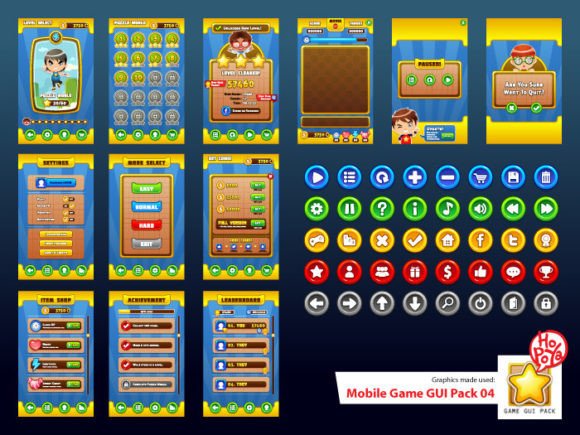
Creating high-quality UI elements from scratch is a time-consuming process that requires a specific set of skills distinct from character or environment art. This is where a robust asset collection becomes invaluable. Mobile Game GUI Pack 04 is designed specifically to bridge that gap, offering a cohesive visual language for 2D games without forcing you to spend weeks in a vector editor. It is not just a collection of random shapes; it is a curated system intended to give your project a professional sheen immediately.
The Anatomy of a Professional Interface
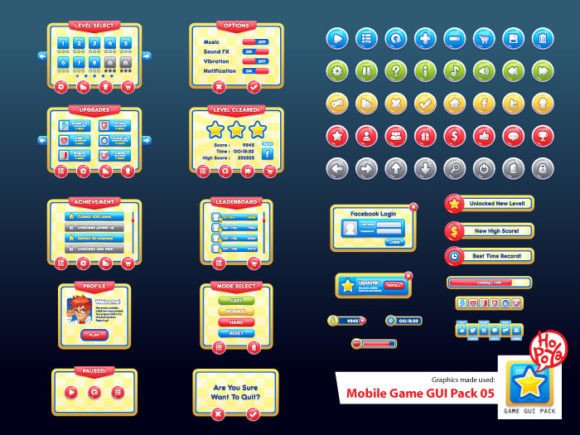
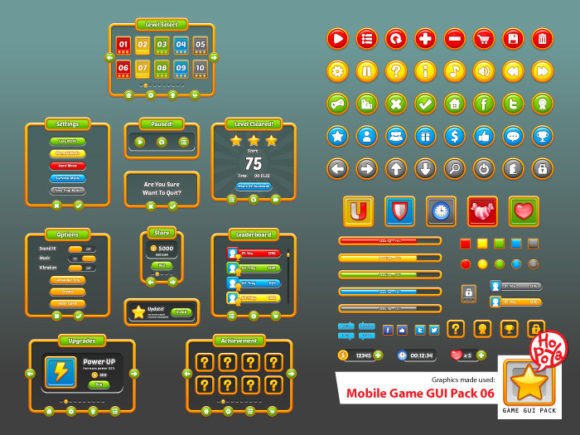
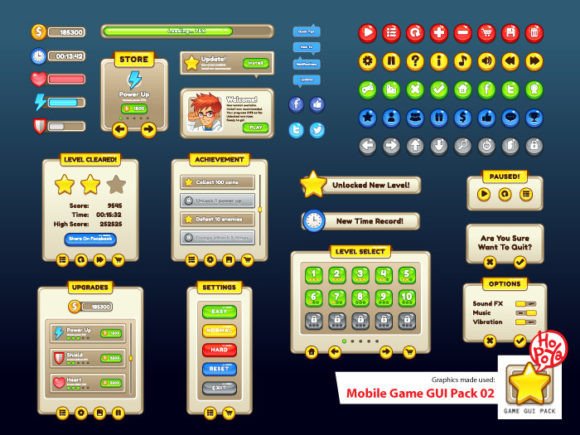
What separates an amateur interface from a professional one often comes down to consistency and detail. When you download a generic UI kit, you often get flat, uninspired graphics. This pack takes a different approach by focusing on customizable window and game elements that maintain a unified aesthetic. Whether you are building an RPG inventory screen, a puzzle game’s level select, or a strategy game’s HUD, the visual style here adapts to the needs of the project.
The true strength of this collection lies in its versatility regarding color theory. We all know that color drives emotion in gaming—red for danger, blue for mana, gold for premium currency. The inclusion of 40+ customizable buttons with 5 different colors allows you to map your UI directly to your game’s psychological triggers without needing to recolor assets manually. This saves an immense amount of production time. Instead of fiddling with hue and saturation sliders, you can drag and drop the element that fits your current design sprint.
Vector Flexibility: Why File Formats Matter
One of the most common frustrations in asset sourcing is receiving a low-resolution JPEG or a rasterized PNG that pixelates the moment you try to scale it up for a tablet or a high-DPI monitor. Modern mobile devices have incredibly sharp screens, and blurriness is the enemy of immersion. This is why the inclusion of Vector AICS and EPS10 files is a critical feature of this GUI pack.
Working with vector source files means you have infinite scalability. You can resize a "Close" button to fit a small smartphone screen or blow it up for a massive menu background on an iPad, and the edges will remain perfectly crisp. For developers using engines like Unity, Unreal, or Godot, having access to the raw vector data allows for easy slicing and exporting at exact pixel dimensions required by the engine. Furthermore, the transparent PNG files included ensure that for those who don't want to open Adobe Illustrator, the assets are ready to be dragged directly into your game engine’s canvas with zero background cleanup required.
Typography: Setting the Mood with Molot and Aller Display
A GUI is more than just buttons and sliders; text is the glue that holds the interface together. The readability of your instructions, item descriptions, and menu headers can make or break the user experience. This pack includes two distinct typefaces that serve different functional purposes: Molot and Aller Display.
Molot is a display typeface that commands attention. It is bold, industrial, and carries a sense of weight. This makes it an excellent choice for headers, title screens, or "Game Over" text where you need immediate visual impact. It fits perfectly into genres like strategy, simulation, or gritty action games where you want the text to feel substantial.
On the other hand, Aller Display offers a cleaner, more humanist sans-serif aesthetic. It is generally more legible at smaller sizes than decorative display fonts, making it suitable for tooltips, menu items, and longer strings of text that players need to read quickly. The pairing of a heavy display font like Molot with a cleaner face like Aller Display is a classic design strategy. It creates a visual hierarchy that guides the player's eye from the headline to the details, ensuring that your visual communication is effective and stylish.
Beyond the Game: Commercial and Creative Applications
While the name suggests a focus on mobile gaming, the utility of high-quality UI assets extends far beyond just coding a game. If you are a content creator, blogger, or marketer, these elements can be repurposed for a variety of commercial projects. The clean, modern vector style fits well with many contemporary design trends.
Consider using these assets for branding and logo design for a tech startup or an e-sports team. The customizable nature of the vectors allows you to modify shapes to fit a specific brand identity. Social media graphics are another prime use case. Creating engaging Instagram Stories or YouTube thumbnails often requires dynamic buttons and UI elements to highlight "Subscribe" or "Link in Bio" calls to action. These graphics provide a polished, professional look that standard stock photos cannot match.
Furthermore, if you are involved in packaging design for tech products or toys, or if you are creating merchandise like sticker sheets or posters, the EPS10 compatibility ensures your printer will love you. Vectors are the industry standard for print because they guarantee sharp lines regardless of the print size. Even for editorial layouts in magazines or digital products like PDF planners, these UI elements add a layer of polish that signals quality to the end-user.
Practical Advice for Implementation
To get the most out of a GUI pack, you need to approach implementation strategically. Here are a few practical tips for integrating these assets into your workflow:
- Establish a Style Guide Early: Even though the pack offers five colors, pick two or three that dominate your palette. Use the others as accents. This prevents your UI from looking like a rainbow explosion and helps with brand recognition.
- Test for Readability: While Molot looks great, ensure that if you use it for body text, it is legible on the smallest target device. If not, switch to Aller Display for those specific instances. Good design is invisible; bad typography is a barrier to entry.
- Layering and Effects: Since you have the source files, don't be afraid to add subtle drop shadows or glows within your game engine to make the UI "pop" against the background. A flat UI looks modern, but sometimes a game requires depth to feel immersive.
- Consistency is Key: Use the same button style for all "confirm" actions and a different style for "cancel" or "back" actions. Players learn through visual repetition. If a green button means "go" in the main menu, it shouldn't mean "delete" in the settings menu.
The Value of Ready-Made Assets
In the world of independent development and small business marketing, time is your most expensive resource. Spending hours drawing individual pixels for a settings gear icon or a slider bar is rarely the best use of a creative professional's time. By utilizing a comprehensive pack like this, you are essentially outsourcing the grunt work of asset creation to a professionally designed system.
This allows you to focus on what makes your project unique—whether that is the core gameplay mechanics, the narrative, or the specific marketing message you are trying to convey. The Mobile Game GUI Pack 04 serves as a foundation. It provides the scaffolding upon which you can build a unique experience. With the combination of scalable vectors, distinct typography, and customizable color schemes, you have the tools to present a polished, professional face to the world. Whether you are launching a hit game on the App Store or designing a sleek pitch deck for investors, having a solid set of GUI assets ensures you look the part.